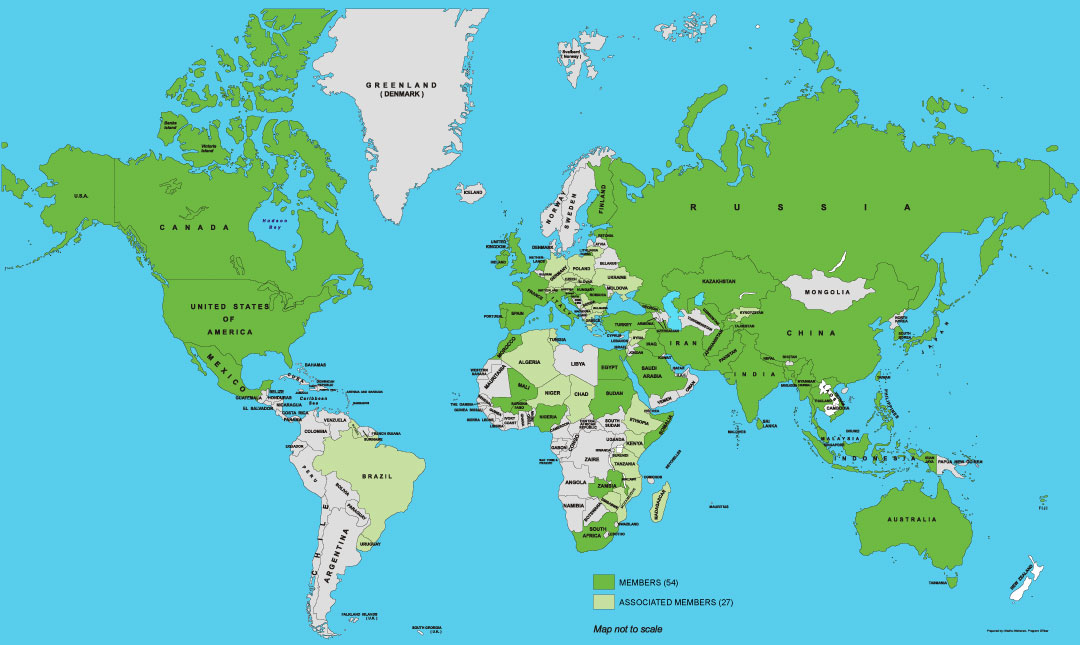
Political boundaries shown may not be accurate
Uzbekistan National Committee on Irrigation and Drainage (UzNCID)
Population (M): 39
Geo. Area (Km2): 448,924
Irrigated Area (Mha): 4.312
Drained Area (Mha): 3.046
Sprinkler Irrigation (Ha): 121,030
Micro Irrigation (Ha): 664,700 Major River Basins (Km2): Amu Darya River and Syr Darya
1 A Labzak Str. Tashkent - 100128
National Committee Directory+
Hon'ble Minister of Water Resources
Country Profile-
Geography
Uzbekistan is a double landlocked country in Central Asia, with a total area of 448 924 Sq.Km. It is bordered in the north and north-west by Kazakhstan (with the total border length of 2,206 km), in the north-east and east by Kyrgyzstan (border length of 1,099 km), in the south-east by Tajikistan (border length of 1,161 km), in the south-west by Turkmenistan (border length of 1,621 km), and in the south by Afghanistan (the border length of 137 km. The country gained its independence from the Union of Soviet Socialist Republics (USSR) in September 1991. Physiographically the country can be divided into three zones: the desert (Kyzylkum, Karakum and newly formed desert - Aralkum), steppe and semi-arid region, mainly the central and western parts; the fertile valleys (including the Fergana valley) that skirt the Amu Darya and Syr Darya rivers; and the mountainous areas in the east with peaks of about 4,643 m above sea level.
Population and land use
The total population was 39 Million as per the State Committee of the Republic of Uzbekistan on Statistics, 1 January 2026. During the period 2025–2026 annual population growth rate was estimated at 1,75%. Population density is about 85.1 inhabitants/km2, which is the highest of the five former Soviet Central Asian republics. Population ranges from more than 727.4 inhabitants/km2 in Andijan province in the Fergana valley in the east to only 11.3 inhabitants/km2 in Karakalpakstan. By January 2026, the total agricultural lands in Uzbekistan cover about 26.7 Mha. Of this amount about 21.2 Mha are pastures and hayfields, actually irrigated croplands – about 3.5 Mha, rain feed lands – about 0.8 Mha and perennial crops – about 0.5 Mha and other categories.
Climate and rainfall
The climate is continental; arid/deserts cover over 70% of the territory. Average annual rainfall is 264 mm, ranging from less than 97 mm in the northwest to 425 mm in the mountainous regions in the center and south. In the Fergana valley, average annual rainfall varies between 98 and 502 mm, while in the Tashkent vilayat, it varies between 295 and 878 mm. Rainfall occurs during the winter and spring periods, mainly between October and April. There are high temperatures 42–47ºC on the plains and 25–30ºC in the mountainous regions in July, and low temperatures in winter, minus 11ºC in the north and 2–3ºC in the south in January. Because of frequent frosts, between late September and April, only one crop a year can be grown. In favorable years, however, double-cropping of vegetables with a short growing period is possible.
Food and agriculture
The total agricultural lands in Uzbekistan cover about 26.7 Mha. Of this amount irrigated croplands – about 3.5 Mha. The volume of agricultural production in Uzbekistan reached 538,9 trillion soums ($44.2 billion) in 2025. The data from Uzbekistan Statistics Agency shows that this included crop and livestock production, hunting and related services - 518,822.7 billion soums, forestry – 15 081.5 billion soums, and fisheries – 5 015.5 billion soums (Nat. Stat. Com., 2025 https://stat.uz/en). Regarding the breakdown by categories of agricultural enterprises, 63.1 percent of the total agricultural production came from dekhkan (smallholder) and household farms, 29.7 percent from farming enterprises, and 7.2 percent from big agricultural organizations.
Uzbekistan targets food security through its Uzbekistan Agri-Food Development Strategy 2020-2030, aiming to expand food export values to $10 billion, increase deep food processing to 25%, and promote climate-resilient farming.
The government also declared the years 2026–2030 as the "Priority Period for Food Security" to improve public nutrition and resource management. Key Goals and Targets are as following:
- Export Growth: Raise total agricultural and food exports to $10 billion annually by 2030.
- Deep Processing: Expand agricultural product processing from 15% up to 25% of total production.
- Income Increase: Target average earnings of $5,000 per hectare of cultivated land.
Irrigation and drainage
In ancient times (from the fourth century before the common era), the irrigated area in the lower reaches of the Amu Darya, Zeravshan and Kashkadarya rivers in Central Asia was about 3.5 Mha. In 2026, the irrigated area only in Uzbekistan was estimated at 4.32 Mha or 20.2 percent of the agricultural area in the country. Due to highly arid climate, about 97.7% of agricultural products in Uzbekistan are produced on the basis of irrigation. It means that irrigation is an extremely important component of the country water and food security. On average, 88% of water resources are used in agriculture. About 44 percent of the total irrigated area is in the Syr Darya basin and 56 percent in the Amu Darya basin.
Irrigation infrastructure includes: more than 180,000 Km of canals, 54,400 hydro structures, 1688 big pumping stations, 4153 irrigation wells and others. About 3.3 Mha of irrigated land require drainage. Most of the drainage systems are open drains. The total length of collector drain channels is more 143,000 Km.
Water resources management
There are 72 reservoirs in Uzbekistan with a total capacity of over 22 km3. The largest reservoirs are multipurpose dams used for irrigation, flood control and hydropower production. In the Syr Darya basin, the largest reservoirs are the Charvak and Andijan reservoirs. In the Amu Darya basin, the largest reservoir is the Tuaymuyun, in Khorezm vilayat, with a storage capacity of 7.8 km3, comprising four separate reservoirs. Two river basins are found in Uzbekistan, which form the Aral Sea basin:
- Amu Darya basin – covers 81.5% of the country. The total flow produced in the Amu Darya basin is an estimated 79.36 km3/year on average, calculated by adding the internal renewable surface water resources (IRSWR) of the different countries in the basin: Tajikistan 49.9 km3/year, Kyrgyzstan 1.6 km3/year, Afghanistan 22.92 km3/year, Uzbekistan 4.82 km3/year and Turkmenistan 0.12 km3/year, while the 5 and 95 percent probabilities are an estimated 108.4 and 46.9 km3/year respectively. About 4.82 km3/year, or 6% of the average total surface water resources of the Amu Darya river basin, are generated within Uzbekistan.
- Syr Darya basin – covers 13.5% of the country. The total flow produced in the Syr Darya basin is an estimated 37.56 km3/year, calculated by adding the IRSWR of the different countries in the basin: Kyrgyzstan 27.61 km3/year, Tajikistan 1.01 km3/year, Uzbekistan 6.17 km3/year and Kazakhstan 2.78 km3/year.
The total river flow generated inside Uzbekistan is thus estimated at 11 km3/year of which 44% from the Amu Darya river basin and 56% from the Syr Darya river basin. The renewable groundwater resources are an estimated 8.8 km3/year, of which 2 km3/year are considered an overlap with surface resources.
Water policies
The fundamental strategic document for water sector is Concept of Water Management development of the Republic of Uzbekistan for 2020-2030, which was approved by Decree of President of the Republic of Uzbekistan No. UP 6024 dated July 10 2020. Concept defines the goals, objectives and 11 priority areas for development of water sector of the Republic of Uzbekistan for medium and long term. As part of implementation of this Concept in period 2021-2025 work was underway to develop the Water Code of the Republic of Uzbekistan, which entered into force on October 31, 2025.
The new Water Code clearly regulates main objective of Water Management Concept for 2020-2030 - "creating necessary conditions to meet ever-growing water needs of population, economic sectors and environment, reliable and safe operation of water facilities and effective management of water resources is one of the means to ensure their rational use, improve land reclamation of irrigated lands, achieve water security in conditions of increasing scarcity of water resources, as well as global climate change". At the same time, the Water Code not only creates conditions for implementation of medium-term objectives for development of water management, defined in Concept, but also creates a legal basis for long-term development of water management, water conservation, efficient use of water resources, attracting investments in water management and serves to create active incentives for technological modernization.
ICID and National Committee
Uzbekistan joined ICID in 1994 and established the Uzbekistan National Committee on Irrigation and Drainage (UzNCID). Some irrigation specialists from Uzbekistan got the global level recognizion. Prof. Victor A. Dukhovny received the prestigious 1st World Irrigation and Drainage Prize during ICID’s First World Irrigation Forum held at Mardin, Turkey in 2013. Prof. Victor A. Dukhovny was also the Vice President of ICID during 2003-2006, and H.E. Shavkat Khamrayev, the Minister of Water Resources of the Republic of Uzbekistan was the Vice President of ICID during 2019-2022. Dr. Vadim Sokolov, Manager of Agency of IFAS is currently the Vice President of ICID (2023-2026). Mr. Ilhom Juraev is the Chairman of UzNCID.
Activities-
Events+
Awards+
Recognized World Heritage Irrigation Structures+
| # | Structure | Built | State | River Basin | Irrigation area | Recognised at |
|---|---|---|---|---|---|---|
| 1 | Eski Tuyatortar Canal | Approximately 2,000 years old | Samarkand | Zeravshan River Zeravshan | 34,000 hectares | 76th IEC Meeting, September 2025, Kuala Lumpur, Malaysia |
| 2 | Dustlik Canal | 1913 | Tashkent and Syrdarya | Syr Darya Syr Darya | 236,000 hectares | 76th IEC Meeting, September 2025, Kuala Lumpur, Malaysia |
Workbody Representation+
| # | Abbreviation | Workbody |
|---|---|---|
| 1 | ASRWG | Asian Regional Working Group
Mr. Juraev Ilkhom Usmanovich (Member), |
| 2 | WG-WFE-N | WG on Water Food Energy Nexus
Eng. Karshiyev Rustum Jurayevih (Member), |
| 3 | PCSO | Permanent Committee on Strategy and Organization
Dr. Vadim Sokolov (Chair), |
| 4 | TF-WEWM | Task Force on Women Empowerment in Water Management
Dr. Vadim Sokolov (Member), |
| 5 | WG-IDSST | WG on Irrig. and Drain. in the States under Socio-Eco. Trans.
Dr. Vadim Sokolov (Member), Mr. Juraev Ilkhom Usmanovich (Member), |
| 6 | WG-IWM&D | Working Group on Irrigation Water Management and Development
Er. Isomiddin Akramov (Member), |
| 7 | IRPID | International Research Program for Irrigation and Drainage
Dr. Vadim Sokolov (Member), |
| 8 | MB | Management Board
Dr. Vadim Sokolov (Member), |